


. National Tax Acts’ll eliminate tax inconsistencies – Prof Awodun
KEHINDE EMMANUEL
Member, Presidential Committee on Fiscal Policy and Tax Reforms, Prof Muritala Awodun, has said that major nationwide tax reforms in the National Tax Acts scheduled to commence in January 2026 will eliminate most of the tax inconsistencies.
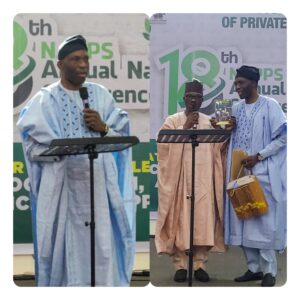 Awodun, who was the Guest Speaker, delivered a lecture on: “Tax Policy, Economic Uncertainties and School Administration in Nigeria,” during the 18th Annual National Conference of by the National Association of Proprietors of Private Schools (NAPPS) in Ilorin, the Kwara State capital, according to a statement on Wednesday.
As part of the event, NAPPS Board of Trustees (BOT) Chairman, Dr. Mijinyawa I. Said, presented the Prof with the Meritorious Service Award in recognition of his outstanding contributions to the advancement of quality education in Nigeria. Awodun, on his part, in further demonstration of his commitment to improving learning nationwide, donated 1,000 copies of his book, “Entrepreneurship for Secondary Schools – Not Just Schooling but Learning,” valued at ₦5,000 per copy, to school owners present at the conference.
Awodun also decried that inflation, currency instability, fluctuating oil prices, unemployment, and inconsistent tax enforcement weaken government revenue and reduce education budgets, thereby affecting both public and private schools.
Drawing on his experience as the former Chairman of the Kwara State Internal Revenue Service where he led reforms that expanded the state’s revenue,and his background as a banker and educator, Prof. Awodun offered an in-depth analysis of Nigeria’s tax landscape.
The Professor of Business and Entrepreneurship explored the evolving landscape of private education and the realities of managing schools in a challenging economic environment.
Awodun, who was honoured with a Meritorious Service Award by NAPPS, highlighted a major structural imbalance within the system.
He asserted that although private schools contribute significantly to the Education system of the nation, the Education Tax Funds are utilized predominantly for public institutions leaving private schools with no direct benefits despite their significant role in uplifting the country’s educational burden.
He commended private school proprietors for bridging the gap created by the declining quality of public education, acknowledging their resilience, accountability, and innovation in sustaining Nigeria’s learning ecosystem.
He noted that school administrators increasingly struggle with budgeting, technology adoption, regulatory compliance, and maintaining educational standards amid unpredictable economic conditions.
To navigate these challenges, he encouraged schools to diversify income streams, strengthen financial planning systems, invest in staff development through partnerships, and adopt technology that boosts efficiency and long-term sustainabilit