

Kwara Orphanage Operators Seek Govt Support To Enhance Child Welfare
* Say Over 14 Millon Children Are In Orphanage Homes In Nigeria
Stephen Olufemi Oni, Ilorin
The Kwara State Coordinator of the Association of Orphanages and Homes Operators in Nigeria (ASOHON), Dr. Mrs. Omolehin Christie, has called for urgent government and public support for orphanages and vulnerable children amid growing economic hardship in the country.
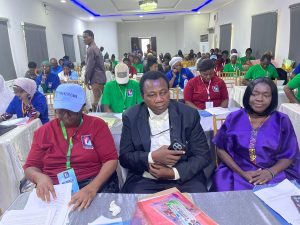 Speaking with journalists on the sideline of a two-day training seminar on Child First Software and Advocacy Visits on Child Care on Thursday in Ilorin, the Kwara State capital, Mrs Omolehin, who is the Proprietress of the Hope Motherless Babies Home Int’l, Idofian, lamented the increasing number of abandoned and vulnerable children finding their way into orphanages due to family breakdown and poverty.
She recounted a heartbreaking case of children brought to her home through the intervention of the family court after both parents had failed to care for them.
“The father’s family could not cater for the children while the mother wanted to take them, but her husband refused to accept them because they were not his biological children. The family court had to step in and bring the children to my home,” she said.
According to her, the children had been denied access to education for years before they were admitted into her facility.
“One of the children was about 12 years old and had never been to school for eight years. When we enrolled them in school, they kept crying because they did not know anything. There are many children in similar situations,” she added.
Mrs Omolehin stressed the need for stronger family support systems to reduce the number of children ending up in orphanages.
“Whatever we can do to save families will help reduce the number of children coming into institutions,” she stated.
The ASOHON Coordinator also identified inadequate funding as one of the major challenges facing orphanage homes across Nigeria, noting that donations have dropped significantly since the time of COVID-19 pandemic.
“Since the COVID-19 outbreak, the number of donors has reduced drastically because many people are also struggling to survive. People who do not have enough for their families can hardly support charity homes,” she explained.
She further decried the poor power supply situation in the country, describing electricity as a major burden for orphanage operators.
“When there is no light, you cannot pump water, the children stay in darkness and cannot enjoy comfort. Power supply remains a serious challenge,” she said.
She revealed that the cost of switching to solar energy was beyond the reach of many orphanage operators.
“I invited a professional to assess my home for solar installation and I was told it would cost about six million naira. How do we raise such money just to provide electricity for the children?” she queried.
She explained that her facility consists of separate sections for boys, girls and babies, making electricity and maintenance costs even higher.
The ASOHON Coordinator also expressed concern over the rising cost of education, disclosing that five children from her orphanage recently gained admission into universities.
“I am happy that five of my children gained university admission last September, but financing their education is a major challenge. We want them to have the same opportunities as other children,” she said.
She appealed to government agencies, corporate organisations and well-meaning Nigerians to support orphanage homes in providing quality care, education and welfare for vulnerable children across the country.
In his speech at the event, the National President of the Association of Orphanages and Home operators in Nigeria (ASOHON), Dr. Gabriel Oyediji has disclosed that no fewer than 14 million children are in Motherless and Orphanage Homes across Nigeria, adding that 95 percent of the figure are in private homes rather than government-sponsored facilities.
He lamented that the private homes are carelessly abandoned by the government thus leaving the children’s schooling, feeding and accommodation to the homes to complicate their existing challenges.
Oyediji, however, hinted that five home operators are currently in police custody in Minna, Niger State over poor documentation and police relationship and approval, urging members not to go against the government by running homes without knowing the laws guiding them.
He stated that philanthropists had lost trust and confidence in homes because of more negative stories about them rather than positive ones, noting that only courage and passion keep them in operations.
Also speaking, the Kwara State Commissioner for Social Development, Hajiya Mariam Nnafatima Imam, stressed the importance of capacity building for caregivers and operators handling vulnerable children, adding that quality child care requires not only compassion but also proper training, improved management skills and adherence to child protection standards.
The Commissioner identified inadequate funding, poor facilities and rising operational costs as some of the major challenges affecting orphanages and homes across the State, appealing to government agencies, corporate organisations, philanthropists and development partners to support the initiative financially to improve the standard of care available to vulnerable children.
She maintained that investing in the training and empowerment of orphanage operators would contribute significantly to building a safer and more compassionate society.