

- A Son Returns: Retired General Erema Akerejola Takes His Father’s Ancestral Stool as Ubuoro of Ogoriland
By Alao Adamadamosi Sunday,arpa
The ancient town of Ogori in Ogori/Magongo Local Government Area of Kogi State stood still on Monday, October 26, 2026, as retired Major General Erema Akerejola was formally installed as the Ubuoro of Ogori Land, succeeding his late father, Professor Olugbemiro Eminefo Akerejola.
The ceremony, held at Opa Quarters in Eni, Ogori, drew dignitaries from across the country, including serving and retired senior military officers, traditional rulers, political leaders, and sons and daughters of Ogori from the diaspora. For a community steeped in tradition, the installation was more than a coronation; it was the closing of a circle that began decades ago when a young boy left home to don the uniform of a soldier.
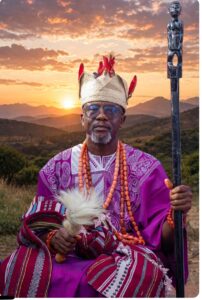 General Akerejola’s path to the throne was anything but conventional. He spent 35 years in the Nigerian Army, rising to the position of Chief of Logistics at Army Headquarters before his retirement earlier in 2026. His career spanned key roles in logistics and field operations, including significant contributions to counter-insurgency efforts in the North-East and reforms that strengthened the Army’s transport and supply systems.
In April 2026, the Nigerian Army honoured him with a full-dress pull-out parade at the Supply and Transport Barracks in Benin City, a ceremony that marked his formal exit from active duty after a career that outlasted four Chiefs of Army Staff. Colleagues described him then as a disciplined and courageous leader whose commitment to national unity inspired subordinates and peers alike.
Yet, as he told Tribune in an interview, the transition to civilian life came with mixed emotions. “I miss waking up every morning and putting on the khaki,” he admitted. “The discipline in the military is unique.” But even then, his thoughts were turning homeward. Speaking of his father’s passing, he said he was “still finding his footing but remains committed to community development,” singling out education and the girl-child as areas close to his heart.
The Ubuoro title is not merely ceremonial. It is a second-class chieftaincy stool historically reserved for a lineage that has served Ogori with truth, peace, and service. General Akerejola’s father, the late Professor Akerejola, held the title for decades and was remembered as a man of peace, a mediator, and a reputable university teacher who kept Eni and the wider Ogori community together.
When the elder Akerejola passed, the stool remained vacant for nearly a year. According to community accounts, the elders were deliberate: “We will not rush. The son who will take this must have his father’s heart and a soldier’s discipline.” The Kogi State Government eventually approved the appointment of the retired General alongside 17 other traditional rulers across the state, following what officials described as due process.
The 26th Age Group of Ogori, of which General Akerejola is a member, described the appointment as “fittingly deserving, meritorious and a round peg in a round hole,” citing his “discipline, humility and service to Nigeria and humanity.”
Long before the crown came calling, General Akerejola had been investing in his community away from the spotlight. In 2024, he was instrumental in the Nigerian Army’s construction and asphalting of a 1.6-kilometre road linking the Community Comprehensive High School in Ogori to township roads. That same year, during the Ovia Osese Festival, he received the Ogori National Merit Award in recognition of his contributions to community development and youth welfare.
More recently, just weeks before his installation, he donated solar panels to Magongo and Ogori communities to illuminate public spaces and boost security surveillance, a gesture welcomed by local development associations. In an interview, he also called on the Kogi State Government to promote the Ovia Osese Festival, describing it as a cultural asset with tourism potential.
His father’s lesson, he said, remains his guiding principle: “My father taught me to always help others. That is the principle I hold dear.”
By 9 a.m. on installation day, Opa in Eni was already filling up. Women in matching aso-ebi and gele danced to Ogori folk songs. Traditional council members arrived in traditional cap known as Okara and flowing agbadas. By 11 a.m., the guest list read like a roll call of Nigeria’s military and civilian elite: former colleagues from the Nigerian Defence Academy, serving officers from Abuja, Lagos, Benin, and Kaduna, and Ogori indigenes who had flown in from London, Toronto, Houston, and New Jersey.
At 11:45 a.m., the siren sounded. Local hunters fired dane guns into the air. General Akerejola entered, not in khaki, but in a colourful agbada with a brown Okara cap. His face was calm, but his eyes were wet. He waved, not with a military salute, but with the traditional wave of a chief with olope.
The drums changed. The Ogori cultural troupe took centre stage. Libations were poured, and the ancestors were called upon to witness the transition. The son of Akerejola had returned.
As the Ubuoro of Ogori Land, General Akerejola assumes a role that is both custodian of culture and bridge between his people and government. Traditional rulers in Nigeria remain vital in preserving indigenous customs, promoting peace and unity, and supporting community development. For Ogori, the hope is that a man who spent his life organising supply chains and mentoring young officers will bring the same discipline and vision to the throne.
In his interview with Tribune, the General was candid about the future: “There are areas where help is needed, particularly in education and encouraging the girl-child. I may not have a specific plan yet, but I am willing to contribute to anything that will improve society.”
It is a modest beginning for a man who once commanded logistics for the entire Nigerian Army. But perhaps that is fitting. The Ubuoro stool is not about commands; it is about counsel. And for a soldier who spent 35 years in uniform, the transition from giving orders to offering wisdom may be the most important mission yet.
As the drums faded over Opa Quarters and the guests departed, one thing was clear: Ogori had not just crowned a chief. It had welcomed home a son.
Alao Adamadamosi Sunday writes from Lokoja.