

UNILORIN Alumnus Raises ₦123m Endowment For Annual Lecture
Stephen Olufemi Oni, Ilorin
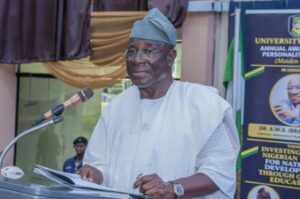
The Chairman of the Governing Council of the Fountain University, Osogbo, Dr Abdulwahab Adeola Ibrahim, has raised the sum of ₦123 million as endowment to ensure the sustainability of his annual lecture at the University of Ilorin, tagged: “AWA Ibrahim Lecture”.
Dr Ibrahim is an alumnus of the University of Ilorin.
The sum comprised ₦50 million personally contributed by him and ₦73 million mobiloised by his family members and friends.
The endowment followed a proposal by the Chairman of the 2026 Dr AWA Ibrahim Annual Personality Lecture, Professor Emeritus Is-haq Olanrewaju Oloyede, CON, for the establishment of a minimum ₦50 million endowment fund to guarantee the continuity of the lecture beyond the tenure of the present University administration.
Prof. Oloyede had stressed the need for Dr Ibrahim to mobilise no fewer than 50 members of his family, friends and associates to support the endowment fund with ₦1 million each, hinging the proposal on his experience with the Is-haq Oloyede Faculty of Arts Annual Lecture, which he sustained through a similar endowment arrangement.
Explaining the rationale behind the proposal, the former Vice Chancellor of the University of Ilorin stressed that establishing an annual lecture required more than goodwill and institutional promises, noting that a sustainable financial arrangement is germane to guarantee its continuity irrespective of changes in University leadership.
 He recalled mobilising 40 friends and family members to contribute ₦20 million as an endowment for his Faculty of Arts Annual Lecture, adding that the investment was designed to generate returns to finance subsequent editions, with his first daughter and whoever emerges as the Dean of the Faculty of Arts serving as custodians of the fund.
Prof. Oloyede, who noted that the University had several faculty-based lectures but was not aware of an established university-wide annual lecture, commended the Vice Chancellor for initiating the programme but cautioned against relying solely on the goodwill of successive administrations.
He observed that the tenure of the present Vice Chancellor would eventually come to an end, making it necessary to establish a permanent funding mechanism to ensure that the lecture survives future changes in leadership.
The former Vice Chancellor also commended the guest speaker, Professor Abel Olayinka, whom he described as an academic of distinction with an exceptional commitment to research and scholarship.
He recalled that Prof. Olayinka had recently delivered three University of Ibadan lectures on November 5, 19 and 26, 2026, in addition to presiding over an academic lecture delivered by the Vice President of Sierra Leone, describing his participation in the UNILORIN event immediately after those engagements as evidence of his passion for education and research.
Congratulating Dr Ibrahim on the recognition, Prof. Oloyede described him as a quiet but highly effective personality whose contributions might not always be immediately visible to those around him.
He observed that the honouree’s disposition reflected a characteristic he associated with the people of Offa, noting that some individuals could be exceptionally productive and influential without necessarily drawing attention to themselves.
Speaking on the lecture’s theme, “Investing in the Nigerian Youth for National Development Through Quality Education,” Prof. Oloyede said he had deliberately chosen to examine the consequences of failing to invest in young people, complementing the guest speaker’s presentation on the importance of investing in the youth.
He identified wasted demographic dividends, erosion of democratic participation, increased health and social crises, weakened national competitiveness, political instability, social unrest, declining economic productivity, reduced Gross Domestic Product (GDP), brain drain, talent flight, escalating crime and insecurity, poverty and unemployment as some of the consequences of inadequate investment in young people.
He warned that a country that failed to develop the capacity of its youthful population would lose the opportunity to harness its demographic advantage for national development.
The former Vice Chancellor also expressed concern over the increasing migration of trained medical professionals, particularly doctors and nurses, noting that the country invested enormous resources in training them only for many to leave in search of better opportunities abroad.
He particularly drew attention to the condition of the general hospital in Ilorin, calling on community leaders, stakeholders and other well-meaning individuals to support efforts to restore the institution to its expected standard as a functional teaching hospital.
Prof. Oloyede described the restoration of the hospital as a collective responsibility, stressing that although individuals with financial resources might seek medical attention in Lagos and other locations, they could not always afford to provide such opportunities for all their relatives and loved ones.
He therefore urged stakeholders to take a greater interest in the hospital’s condition and contribute towards its revitalisation for the benefit of the university community and people in surrounding areas.
He further challenged Nigerians to embrace personal responsibility and productive engagement, particularly in agriculture, rather than depending entirely on the efforts and resources of others.
Using everyday agricultural activities as examples, he asked how many Nigerians could boast of planting crops such as yam, pepper and tomatoes or raising even a rabbit for personal consumption and economic contribution.
He encouraged individuals, irrespective of their social status and professional achievements, to dedicate a portion of their resources and efforts to productive activities, observing that modern technology had made small-scale agricultural production increasingly accessible.
Prof. Oloyede maintained that national development required collective contributions from citizens, adding that everyone had a responsibility to give back to society after benefiting from the labour and sacrifices of others.