

The Kogi Livestock Productivity and Resilience Support (L-PRES) Project, has commenced a two-day capacity building training on meat hygiene, safety and sanitation for 300 butchers, abattoir workers and meat sellers across the three senatorial districts of the state.
The training, organised in partnership with Bridge Agrocare Solutions, held from Monday 2nd to Saturday 7th November 2026 in Kogi West, Central and Eastern Senatorial Districts.
T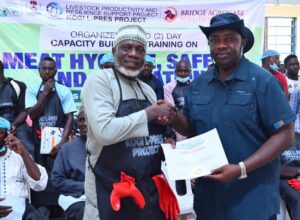 he training in Lokoja featured a practical session at the newly constructed Model Slaughter House at the Lokoja Main Abattoir, Felele, with demonstration of hygienic practices at different operations within the abattoir.
Speaking at the training, the State Project Coordinator of Kogi L-PRES, Mr Otaru Abdulkabir Onoruoyiza, said the project was training 300 participants in the category of butchers, meat sellers, abattoir and sanitation workers, as well as veterinary officers across the state.
Otaru said 100 participants each would be trained from Kogi West, Central and East, noting that the Lokoja training covered Kogi West, while Kogi Central and East would hold in Okene and Anyigba from Wednesday 4th to Saturday 7th November 2026
“We are building the capacity of butchers, meat sellers, abattoir workers, sanitation and veterinary officers on meat hygiene, safety and sanitation.
“Before now, Kogi L-PRES has constructed eight model slaughter houses and eight wet markets across the state. Some have been completed while others are at advanced stages.
“We want to ensure the direct beneficiaries that will utilise these facilities have the capacity to maintain them and ensure that meat consumed by the public is standard, safe and hygienic,” he said.
He explained that the L-PRES project has a mandate to ensure food safety under the One Health approach, from production to processing/value addition and consumption, to ensure meat consumed does not become poison to the body and a challenge to public health.
He said the project had also rehabilitating and upgrading nine livestock markets across the state and improved facilities at the model slaughter houses with lairage, holding pen, water facilities and waste management system with biodigester for converting abattoir waste to wealth.
“The objective is to have a livestock value chain system that can improve productivity, enhance means of livelihood and ensure food safety and security,” he said.
Otaru said the 300 trainees were Trainers-of-Trainers (ToT) expected to step down the training to at least 10 persons each in their respective livestock value chain clusters, to expand the reach.
He disclosed that L-PRES, a six-year World Bank-supported project now in its fourth year, had supported over 27,000 beneficiaries across the state with livestock farm inputs, Pasture Farm Inputs, productive assets, access to capacity building training, artificial insemination for breed improvement, vaccination and livestock infrastructure facilities in the state.
He assured that the target of 30,000 direct beneficiaries would be met and surpassed before the end of the project in 2028.
He thanked and appreciate Gov. Ahmed Usman Ododo for his political will and consistent payment of counterpart funds for the implementation of L-PRES Project to develop the livestock sector in the state.
Also speaking, the Lead Facilitator and Managing Director of Bridge Agrocare Solutions, Dr. Majeed Baje, said the essence of the training was to educate butchers on hygienic handling of meat meant for consumption to ensure public health.
Baje said the training covered ante-mortem and post-mortem inspection, roles of stakeholders and enforcement of standard operating procedures in abattoirs.
He advised the trainees to imbibe the knowledge acquired and replicate it in their various operations, stressing that personal hygiene and occupational safety were critical to ensuring safe and wholesome meat for public consumption.
In his remarks, the Chairman, Nigerian Veterinary Medical Association (NVMA), Kogi Chapter, Dr Tolu Omotugba, said he was impressed with the transformation at the Lokoja abattoir, which previously suffered poor hygiene.
“There is now sufficient water, a clean environment for slaughter and for rinsing meat. Going forward, meat going to the market will be clean and hygienic and this will reduce the rate of meat-borne diseases,” Omotugba said.
He commended Kogi L-PRES and the State Government for the facility and urged butchers to work closely with meat inspectors and allow them access for inspection in the interest of public health.
On his part, the Chairman, Kogi Butchers Union, Alhaji Idi Ibrahim, expressed gratitude to Gov. Ododo for fulfilling his promise to build the model slaughter house and wet market.
Ibrahim said the union had put measures in place to manage and preserve the facility and would adhere to all lessons learnt during the training.
Facilitators presented modules on introduction to meat hygiene and One Health, personal hygiene and occupational safety, meat inspection and hygienic dressing, zoonoses and meat-borne diseases, environmental sanitation, meat storage and transportation, and regulatory compliance.
Participants commended the organisers, describing the initiative as timely to improve meat safety and public health in the state.