
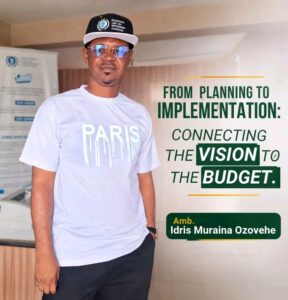
FROM PLANNING TO IMPLEMENTATION: CONNECTING THE VISION TO THE BUDGET.
A development plan is only as valuable as the progress it produces.
Last year, I was privileged to participate in a high-level State Government engagement on the operationalisation of the Kogi State Development Plan 2024–2056, a 32-year roadmap anchored on three pillars: Fostering Prosperity, Building Resilience and Providing Direction, across fourteen (14) critical sectors.
 The engagement focused on translating this long-term vision into actionable sector plans, institutional strategies and a coordinated development pathway for Kogi State. The session produced far reaching recommendations that were duly adopted and approved at the SEC.
Today, I find myself returning to a fundamental question: How do we move from having a development vision to consistently delivering on it?
This question informed my contribution at the preparatory Town Hall Meeting for the formulation of the 2027 Kogi State Budget, where I presented a paper titled “From Budgeting as an Annual Ritual to Budgeting for Transformation.”
I emphasised that annual budgets must do more than make provisions for expenditure. They must connect directly to the State’s long-term development priorities, respond to people’s needs and provide measurable indicators of progress.
From functional public water systems and sustainable mass transportation to affordable housing, a cleaner Lokoja, stronger development data and transparent budget reporting, our priorities must translate into visible improvements in people’s lives.
The 32-Year Development Plan provides the destination. Annual budgets must provide a credible pathway, while implementation must provide the evidence of progress.
As a member of the civic space, I remain committed to asking the necessary questions, tracking commitments, engaging institutions and ensuring that development conversations remain connected to the people they are meant to serve.
Ultimately, Kogi’s development story should not be measured only by the plans we formulate or budgets we approve, but by the difference they make in the everyday lives of our people.