
AGRICULTURE AND TECHNOLOGY: SYNERGY, BENEFITS, AND THE HIDDEN COSTS OF INTEGRATION
Agriculture and technology have become increasingly interdependent as global food demand rises alongside pressures from climate change, population growth, and shrinking arable land. Technology has transformed agriculture from a largely labor-intensive practice into a data-driven, precision-oriented system. While this integration promises higher productivity and sustainability, it also introduces risks that can undermine long-term agricultural resilience if not carefully managed.
 THE RELATIONSHIP: FROM SYMBIOSIS TO SYSTEM
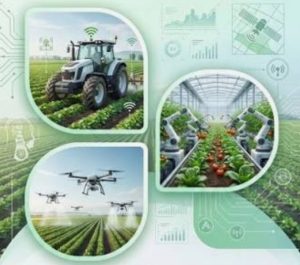
The relationship between agriculture and technology is rooted in efficiency and control. Technologies such as precision farming tools, satellite imagery, drones, biotechnology, automated irrigation systems, and artificial intelligence enable farmers to monitor soil health, crop growth, weather patterns, and pest activity with remarkable accuracy. This data-centric approach allows for informed decision-making, reducing guesswork and optimizing input use.
Historically, technology served agriculture—the plow, the irrigation channel. Today, agriculture is being absorbed into technological systems. The relationship is no longer of tool and field, but of platform and data-point. The farm becomes a node in a network, the crop an output of an algorithm, and the soil a variable in a climate model. This is the shift from agriculture as a culture to agriculture as applied data science.
 THE BENEFITS: THE LOGIC OF ABUNDANCE
The benefits of merging agriculture with technology are substantial, driven by the need to feed a growing population on a degraded planet
• Precision as Salvation: GPS-guided tractors, AI-driven drip irrigation, and drone-monitored crop health minimize waste with surgical precision. This efficiency is critical for feeding 10 billion people within planetary boundaries.
• Resilience by Design: CRISPR-edited crops resist blight, vertical farms defy droughts, and predictive analytics preempt pestilence. Technology builds arks against a climate in flux.
• The Liberation from Scarcity Mindset: By decoupling yield from acreage and weather, AgTech posits a future of post-scarcity food production, freeing human ingenuity and land for other purposes.
THE DISASTERS: THE PATHOLOGY OF OPTIMIZATION
However, the integration of agriculture and technology is not without serious drawbacks. One major disaster is increased dependency on complex and expensive technologies, which can marginalize small-scale farmers who lack capital, technical skills, or access to infrastructure. This deepens inequality within the agricultural sector.
Another risk lies in environmental and ecological imbalance, particularly through excessive reliance on genetically modified crops, chemical inputs, and monoculture systems driven by technological efficiency rather than biodiversity.
Data vulnerability and system failures also pose threats; a breakdown in digital systems, cyberattacks, or inaccurate data can disrupt entire production cycles.
1 • The Monoculture of Everything: Optimization demands standardization. This leads not just to genetic monocultures in fields, but to a monoculture of practice, thought, and risk. A single algorithm, a universal seed patent, or a cascading software failure could trigger systemic collapse across global food chains.
2 • The Erosion of Contextual Wisdom: When farming is reduced to executing code, the deeply place-based knowledge of soil, microclimates, and ecological relationships—accumulated over generations—is rendered obsolete and lost. The farmer becomes a technician, and the land a factory floor.
3 • The Control Paradox: We seek to control nature to ensure survival, but the technological systems we create develop their own uncontrollable inertia. The pursuit of optimal output locks us into dependency cycles—on proprietary seeds, patented chemicals, and constant software updates—eroding food sovereignty and resilience.
4 • The Metric Blindness: Technology excels at measuring what is easily quantifiable: yield, growth rate, profit. It is blind to what is not: soil vitality, ecosystem health, community well-being, and the intangible beauty of a diversified landscape. In optimizing for the former, we silently sacrifice the latter.
For optimal output, the merger of agriculture and technology must be guided by balance rather than blind adoption. Policies should promote inclusive access, farmer education, and context-appropriate technologies that complement local knowledge. Sustainable integration prioritizes ecological health, social equity, and long-term resilience alongside productivity gains.
The critical task is not to halt technological integration, but to redirect its purpose. We must move from extraction-based optimization to regeneration-based stewardship.
This requires a new paradigm: using technology as a diagnostic tool rather than a prescriptive master. Drones should monitor biodiversity health, not just pest locations. AI should model polyculture outcomes, not just monoculture yields. Data should empower farmer wisdom, not replace it.
The ultimate measure of success cannot be “optimal output” alone. It must be the enduring health of the land, the robustness of our food systems, and the preservation of both ecological and human community. The true harvest lies not in dominating nature with technology, but in using technology to listen to it more deeply—and to farm with a wisdom that numbers alone can never contain.
In conclusion, agriculture and technology form a powerful partnership capable of transforming global food systems. When thoughtfully integrated, technology enhances efficiency, sustainability, and resilience. But when mismanaged on the other hand, it risks exclusion, environmental harm, and systemic vulnerability. The challenge, therefore, is not whether agriculture should embrace technology, but how it can do so responsibly to secure both present productivity and future stability for mankind.
The question is HOW CAN WE INCORPORATED AGRIC & TECH without disrupting old techniques, while infusing new/modern mechanisms?
 By : Peter Mosinamofan AJAYI
Founder, Namofan
Agrotech Solutions Ltd
namofanagrotechsolutions@gmail.com