

The Court of Appeal in Abuja has reserved judgments in the appeals seeking to set aside the judgment of the Federal High Court that ordered the Independent National Electoral Commission (INEC) to deregister the African Democratic Congress (ADC) and four other political parties.
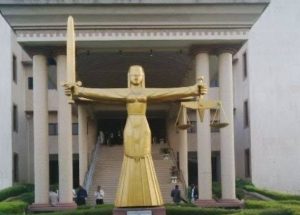 A three-member panel of the Court of Appeal, led by Justice Abba Bello Mohammed on Tuesday reserved judgments to a date that would be communicated to parties after all parties adopted their respective briefs of argument.
Apart from the ADC, other political parties challenging the Federal High Court’s judgment delivered by Justice Peter Odo Lifu are the Action Peoples Party (APP), Action Alliance (AA), Accord Party (AP) and the Zenith Labour Party (ZLP).
Musibau Adetunbi SAN who represented Accord Party urged the Appeal Court Justices to allow the appeal, void and set aside the Federal High Court judgment for being a nullity.
He argued that Justice Peter Lifu who issued the de registration order erred in law because his findings and conclusions were based on facts not supported any law.
Adetunbi SAN faulted the high Court judgment on various grounds and pleaded with the Court of Appeal to throw it away in the interest of justice.
The Court of Appeal had on June 16 granted a stay of execution of the High Court’s judgment and took a swipe at Justice Lifu for refusing to stay proceedings in the matter as ordered by the appellate Court being higher in the judiciary hierarchy.
The appellate court held that Justice Lifu ignored its earlier order of May 22 directing him to stay proceedings pending the determination of an interlocutory appeal.against his ruling and despite being notified of the order.
The Court of Appeal described his conduct as “a form of judicial impertinence ,” noting that the Supreme Court had previously held that such conduct amounts to “judicial rascality” and is unbecoming of a judicial officer.
Justice Lifu had ordered INEC to deregister the five political parties on the grounds that they failed to meet the constitutional requirements necessary to retain their registration.
The court also restrained INEC from recognizing the affected parties, accepting nominations from them, or allowing them to participate in the 2027 general elections.
Justice Lifu further ordered the parties to stop presenting themselves as registered political parties, holding that the suit filed by the National Forum of Former Legislators (NFFL) had merit.
A body operating under the aegis of National Forum of Former Legislators NFL instituted the suit marked FHC/ABJ/CS/2637/2026, against the five political parties.
NFFL through its lawyer Rabo Mohammed had argued before the high court that INEC has a constitutional obligation under Section 225A of the 1999 Constitution (as amended), the Electoral Act 2022, and INEC Regulations to deregister political parties that fail to meet the prescribed electoral performance thresholds.
The plaintiffs maintained that the affected parties failed to satisfy the constitutional benchmarks, including winning at least 25 percent of the votes in a state during a presidential election or securing at least one elective seat at the federal, state, or local government level.
According to the NFFL, the ADC and the four other parties failed to meet these requirements in the 2023 general elections and subsequent by-elections, making their continued recognition by INEC unlawful.
The Attorney General of the Federation and Minister of Justice, Prince Lateef Fagbemi, SAN, who is also a defendant in the suit, supported the plaintiffs’ position.
In his court filings, the AGF argued that allowing the parties to remain registered violates the provisions of the Constitution and undermines the integrity of Nigeria’s electoral system.
He further contended that INEC would continue to breach its constitutional obligations unless the court intervened.
However, dissatisfied with the FederalHigh Court’s decision, all the defendants, including INEC, appealed the judgment and urged the Court of Appeal to set it aside.
Justice Abba Mohammed supported by Justices Donatus Okorowo and Oyebisi Oyebola Oyewumi after taking arguments of respective lawyers announced that a date for the judgment delivery would be communicated to all parties.