

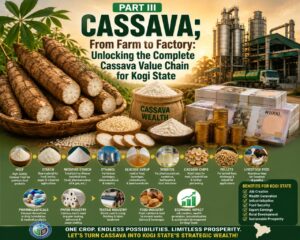
From Farm to Factory: Unlocking the Complete Cassava Value Chain for Kogi State
By Henry Oseka Orire Esq.
Third in a Series
The economic future of cassava does not lie beneath the soil.
It lies inside factories.
For generations, cassava has been cultivated primarily as a food crop, harvested for gari, fufu, lafun and other traditional staples. While these products remain indispensable to food security, they represent only a fraction of the crop’s true economic potential.
The world’s leading cassava economies have demonstrated that the greatest wealth is generated not by selling fresh roots, but by converting them into industrial raw materials demanded by food manufacturers, pharmaceutical companies, textile producers, paper mills, livestock feed manufacturers and biofuel industries.
This is where Kogi State’s greatest opportunity resides.
If the State succeeds in establishing a modern processing ecosystem, cassava will cease to be viewed merely as an agricultural commodity. It will become the foundation of an integrated manufacturing economy capable of supplying both domestic industries and international markets.
Thinking Beyond Gari:
One of the principal limitations of Nigeria’s cassava economy has been the concentration of production around traditional food products.
Although gari, fufu, tapioca and lafun enjoy strong domestic demand, their markets are relatively limited compared to the enormous industrial demand for processed cassava derivatives., hence, the objective of Kogi State should therefore not be to replace traditional products.
Rather, it should expand the value chain so that every harvested root is directed towards its highest-value commercial use.
A modern cassava economy ensures that virtually every component of the crop generates economic value.
High Quality Cassava Flour: A Gateway to Industrial Processing
One of the most commercially significant products is High Quality Cassava Flour (HQCF).
Unlike traditional cassava flour produced through fermentation, HQCF is manufactured under controlled industrial conditions, producing a clean, odourless flour with consistent quality suitable for industrial applications.
HQCF is used in:
bread production;
biscuits;
noodles;
pastries;
breakfast cereals;
confectionery;
adhesives;
plywood manufacturing; and
several food-processing industries.
Its importance extends beyond food manufacturing. By partially substituting imported wheat flour where technically appropriate, HQCF can reduce foreign exchange demand while stimulating domestic agriculture. Research institutions in Nigeria have for years promoted HQCF for industrial applications where product specifications permit, demonstrating its potential in bakery and manufacturing sectors.
For Kogi State, large-scale HQCF production would provide a stable industrial market for thousands of cassava farmers while encouraging private investment in milling facilities.
Industrial Starch: The Cornerstone of Modern Manufacturing
Perhaps no cassava product offers broader industrial applications than starch.
Industrial starch serves as an essential input in numerous manufacturing processes, including:
paper production;
textile finishing;
food manufacturing;
pharmaceutical formulation;
adhesives;
packaging materials;
cosmetics; and
biodegradable products.
 Demand for starch extends far beyond the food industry:
Paper manufacturers rely on starch to improve paper strength.
Textile industries utilise starch during yarn sizing and fabric finishing.
Food manufacturers employ starch as a thickener, stabiliser and texture enhancer.
Pharmaceutical companies use starch as an excipient in tablet production.
This diversity of applications makes starch one of the most commercially attractive investments within the cassava value chain.
Modified Starch: Creating Higher Industrial Value
While native starch already commands significant commercial demand, further processing creates modified starch, a product with even greater industrial value.
Modified starches are engineered to perform under specialised manufacturing conditions. They possess improved stability, viscosity, heat resistance and processing characteristics. Consequently, they are widely used in:
processed foods;
pharmaceuticals;
paper manufacturing;
textiles;
oil drilling fluids;
packaging;
construction chemicals; and
specialised industrial applications.
Producing modified starch within Kogi State would move the economy further up the industrial value chain, creating higher profit margins and attracting technologically advanced manufacturing investment.
Ethanol: Energy, Industry and Healthcare
Cassava is also an important feedstock for ethanol production. Industrial ethanol has numerous commercial applications. It is utilised in:
pharmaceutical manufacturing;
medical disinfectants;
cosmetics;
beverages (where permitted by law);
industrial solvents;
chemical manufacturing; and
fuel blending programmes.
As countries pursue cleaner energy alternatives and strengthen industrial production, ethanol continues to play an important role in multiple sectors.
For Kogi State, ethanol production would diversify industrial output while supporting both domestic manufacturing and export opportunities.
Glucose Syrup and Sorbitol: Supplying the Food and Pharmaceutical Industries
Few consumers appreciate that many everyday products contain cassava-derived ingredients.
Glucose syrup is extensively used in:
confectionery;
beverages;
ice cream;
bakery products;
processed foods; and
pharmaceutical formulations.
Similarly, sorbitol, a sweetening and moisture-retaining compound produced from glucose—is widely used in:
toothpaste;
cosmetics;
pharmaceuticals;
vitamin preparations;
chewing gum; and
sugar-free food products.
These products command significantly higher commercial value than raw cassava and create opportunities for sophisticated manufacturing industries.
Rather than exporting low-value raw materials, Kogi State should encourage investment in facilities capable of producing these refined industrial products.
Cassava Chips and Pellets: Export-Ready Commodities
Not every cassava product requires highly sophisticated processing.
Cassava chips and pellets occupy an important position within international trade. They are widely used in:
livestock feed manufacturing;
industrial starch production;
ethanol processing; and
export supply chains.
Compared with fresh cassava roots, chips and pellets are easier to store, easier to transport and possess substantially longer shelf lives. This makes them particularly suitable for export.
Establishing drying and pelletising facilities across cassava-producing zones would significantly reduce post-harvest losses while increasing farmers’ access to commercial markets.
Livestock Feed: Integrating Agriculture
Again, one of the very promising opportunities lies in integrating cassava production with livestock development, especially now that the Federal Government’s Grazing Reserves is gaining momentum.
Cassava chips, peels and processing by-products can be incorporated into feed formulations for poultry, pigs and certain ruminants when properly processed and balanced with other nutrients.
Rather than treating cassava residues as waste, Kogi State should encourage their conversion into commercial animal feed ingredients.
Such integration would:
reduce feed costs;
stimulate livestock production;
create additional enterprises;
minimise environmental waste; and
increase farmers’ overall profitability.
In a truly circular agricultural economy, very little of the harvested crop should be discarded.
Pharmaceutical Applications
The pharmaceutical industry represents another high-value destination for cassava derivatives.
Refined cassava starch is widely used as a tablet binder, filler and disintegrant in medicine manufacturing.
As Nigeria seeks greater self-sufficiency in pharmaceutical production, reliable domestic supplies of pharmaceutical-grade starch could reduce dependence on imported excipients while supporting local drug manufacturers.
Although pharmaceutical production requires strict quality assurance and regulatory compliance, the long-term economic benefits justify strategic investment in this segment of the value chain.
Supporting Paper and Textile Industries
The industrial relevance of cassava extends beyond agriculture and food.
Paper manufacturers utilise starch to improve surface quality and strength.
Textile factories rely upon starch during weaving and finishing operations. Packaging manufacturers also depend on starch-based adhesives.
These industries already consume substantial quantities of starch globally. By locating starch-processing facilities within Kogi State, Government would create opportunities to supply manufacturers throughout Nigeria and, ultimately, neighbouring West African countries.
Building an Industrial Cluster Rather Than Isolated Factories
Economic transformation will not occur through one factory alone. It requires an industrial ecosystem. Government should therefore designate cassava processing zones where complementary industries operate in close proximity.
Within such clusters, one processing facility could produce starch. Another could manufacture glucose syrup. Another could produce ethanol. Yet another could specialise in livestock feed.
Supporting enterprises would naturally emerge to provide:
packaging materials;
engineering services;
machine fabrication;
laboratory testing;
logistics;
cold storage;
transport;
maintenance services; and
export documentation.
Industrial clustering reduces production costs, encourages innovation and attracts additional investment.
Nothing Should Go to Waste
Perhaps the defining characteristic of a mature cassava economy is that virtually nothing is wasted. Fresh roots become flour, starch or ethanol. Peels become livestock feed or organic fertiliser.
Wastewater can be treated and reused for industrial purposes where appropriate.
Organic residues may be converted into compost or biogas, helping reduce environmental impact while creating additional value. This philosophy of resource efficiency ensures that every stage of processing contributes to profitability.
From Agriculture to Industrialisation
The significance of the cassava value chain extends far beyond farming. It represents a blueprint for industrial development because, ultimately, every processing stage creates new factories. Every factory creates skilled and unskilled jobs. Every job generates household income. Above all, every successful enterprise contributes taxes, stimulates commerce and expands the State’s internally generated revenue.
The true wealth of cassava therefore lies not in the quantity harvested each season, but in the number of industries sustained by that harvest.
For Kogi State, this distinction is transformational.
A tonne of cassava sold as fresh roots generates modest income. The same tonne processed into flour, starch, glucose syrup, ethanol, pharmaceuticals or specialised industrial products creates multiple layers of economic value before it reaches the final consumer. That is the essence of modern agricultural industrialisation.
And most importantly, it is also the pathway through which cassava can evolve from a rural subsistence crop into one of the most powerful drivers of sustainable economic prosperity in Kogi State and it’s farmers.
©Henry Oseka Orire is a Lawyer, Public Commentator and Political Analyst.