

Labour Lauds Gov AbdulRazaq’s Worker-focused Reforms
* Expresses satisfaction over payroll issues
Stephen Olufemi Oni, Ilorin
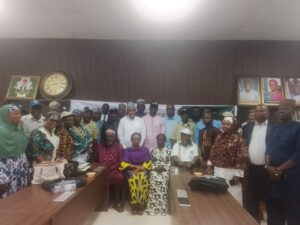
The Kwara State Government and organised labour have strengthened mutual understanding following a three-day sensitisation programme that provided labour leaders with detailed insight into the State’s payroll system and helped clarify concerns and misconceptions surrounding salary and pension administration.
Following the technical sessions and interactive discussions, labour representatives acknowledged that a better understanding of the processes, statutory requirements and institutional responsibilities involved in payroll administration had clarified several issues that had previously generated concerns.
 They noted that the Kwara State Government and the Ministry of Finance had been carrying out their respective responsibilities within the established framework of payroll administration and public financial management.
The programme, organised by the Ministry of Finance in collaboration with the Office of the Accountant-General, brought together labour leaders, government officials and other stakeholders to examine salary computation, statutory deductions, remittances, monthly payroll variations, and the responsibilities of institutions involved in salary and pension administration.
Speaking at the event, the Commissioner for Finance, Dr Hauwa Nuru, said the initiative reflected Governor AbdulRahman AbdulRazaq’s administration’s commitment to transparency, accountability, constructive engagement, and the welfare of workers and pensioners.
She explained that salary payment is not an automatic process but the outcome of a structured monthly exercise involving several institutions and inputs from various Ministries, Departments and Agencies.
According to her, appointments, promotions, retirements, transfers, allowances, deductions, loans and other approved adjustments must be properly captured before computation, verification, reconciliation and statutory processing, leading to the preparation, approval and payment of the final payroll.
Dr Nuru clarified that the Office of the Accountant-General remains directly responsible for preparing and managing the State payroll, while the Ministry of Finance provides oversight within the broader framework of public financial management, transparency and accountability.
The Commissioner also clarified the role of the State payroll consultant, noting that the Government recognises the need for specialised technical expertise in payroll administration.
She stressed that the engagement of consultants to provide technical support for salary administration and payroll management was not introduced by the present administration.
“Over the years, including before the present administration, the Kwara State Government has engaged consultants to provide technical support for salary administration and payroll management,” she said.
Dr Nuru explained that the Kwara State Government duly engaged the present State payroll consultant to provide professional and technical support in the payment of salaries and pensions.
She stressed, however, that engaging a consultant does not transfer the Government’s statutory responsibility for payroll management and approval.
“The Office of the Accountant-General remains directly responsible for payroll preparation, while the Ministry of Finance provides oversight. The consultant operates strictly within the scope of its engagement,” she said.
The Commissioner commended Governor AbdulRazaq for providing the leadership and support that have enabled the State to continue strengthening its public financial management systems through payroll reforms, digitalisation and improved verification processes.
She highlighted the State Staff Identification Number (SSID) as a key reform designed to improve the accuracy and reliability of personnel records and strengthen payroll integrity.
Dr Nuru further noted that Governor AbdulRazaq’s administration has consistently prioritised the welfare of workers and pensioners through regular salary and pension payments, settlement of inherited salary and pension arrears, and sustained efforts to clear outstanding gratuity liabilities.
She said the administration had committed more than ₦30 billion towards clearing inherited gratuity liabilities, while also implementing the ₦30,000 and subsequently ₦70,000 minimum wages, alongside consequential adjustments.
The administration also introduced a 30 per cent Peculiar Allowance, bringing the effective minimum wage to about ₦91,000, and implemented 100 per cent CONMESS and CONHESS for eligible health-sector professionals.
The Permanent Secretary, Ministry of Finance, Mallam Folorunsho AbdulRasaq, said the sensitisation programme was organised to bridge communication gaps and create a stronger platform for regular engagement, clarification and constructive dialogue between the Government and organised labour.
The Senior Special Assistant to the Governor on Labour, Alhaji Abdulkareem Abdulmumeen Onagun, described Governor AbdulRazaq as a worker-friendly governor and commended the administration’s sustained efforts to improve workers’ welfare.
Representatives of the labour unions described the sensitisation programme as the first of its kind and an important opportunity to gain a clearer understanding of the processes, computations, statutory obligations and institutional responsibilities involved in salary and pension administration.
They acknowledged that the detailed explanations and technical sessions helped clear previous misconceptions and better explain the roles of the Government, the Ministry of Finance, the Office of the Accountant-General and the payroll consultant.
The labour leaders consequently expressed satisfaction with the clarifications provided and called for the sensitisation programme to continue as a regular platform for engagement, dialogue and resolution of concerns affecting workers and pensioners.
The technical sessions featured presentations by the Deputy Accountant-General, Hajia Ashiata Yetunde Abdulraheem, on “An Overview of the Principles and Practice of an Effective Payroll System in the Public Sector,” and Mr Oladunni Alaba Olarewaju on “Understanding Salary Computation, Payroll Deductions, Remittances and Monthly Variations.”
Dr Nuru urged participants to sustain the spirit of dialogue, stressing that Government and organised labour have complementary responsibilities but share a common objective of building a stronger public service and improving the welfare of workers and pensioners.
“With better understanding comes better communication; with better communication comes stronger trust; and with stronger trust and partnership, we can achieve even more for our workers, pensioners and the people of Kwara State,” she said.