

WHY YAGBA FEDERAL CONSTITUENCY MUST VOTE SEUN IBIGBEMI
2027: The Time for Equity, the Time for Renewal, the Time for Mopamuro
La’Niyi Africa
Politics is not a permanent inheritance.
Leadership is not the exclusive property of one community.
And representation cannot forever operate on the assumption that some people must wait indefinitely while others repeatedly take their turn.
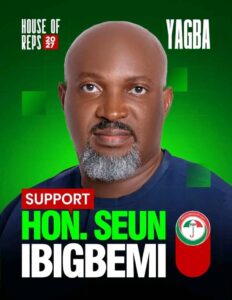 For Yagba Federal Constituency, 2027 presents a defining political choice.
It is a choice between the comfort of political continuity and the courage of political renewal.
It is a choice between merely repeating the past and deliberately creating a more equitable future.
And increasingly, one name stands at the centre of that conversation:
SEUN IBIGBEMI.
THIS IS NOT JUST ABOUT SEUN. IT IS ABOUT YAGBA.
Those who reduce the Seun Ibigbemi movement to the ambition of one politician are missing the bigger picture.
The real issue is representation.
The real issue is equity.
The real issue is whether every component of Yagba Federal Constituency can genuinely aspire to the highest levels of representation without being told to wait indefinitely.
This is why “Mopamuro Ló’kàn” has become a political statement with increasing resonance.
It is not a cry for privilege.
It is not a demand for entitlement.
It is a demand that the principle of fairness should mean something in practical politics.
If democracy is about inclusion, then inclusion must be visible.
If equity is a political principle, then equity must be practised.
And if Yagba belongs to all of its people, then no community should be permanently treated as a spectator in the distribution of political opportunities.
THE QUESTION THAT MUST BE ASKED
For too long, political conversations can become trapped in personalities.
Who has the structure?
Who has the influence?
Who has been there before?
Who has the strongest political machinery?
But the people should ask a more fundamental question:
What is fair?
And immediately after that:
Who is capable of turning that fairness into effective representation?
That is where Seun Ibigbemi must be judged.
Not merely by where he comes from.
Not merely by the slogan attached to his campaign.
But by his capacity, his vision, his understanding of the people and his ability to translate representation into tangible opportunities for the constituency.
MOPAMURO LÓ’KÀN — BUT WHAT COMES AFTER THE TURN?
This is perhaps the most important question.
A political turn means very little if it produces no transformation.
Mopamuro is not simplying say “it is our turn.”
The bigger declaration is:
It is our turn to serve.
Our turn to unite.
Our turn to deliver.
Our turn to open more and better doors for our people.
Our turn to make representation count and reward of stewardship accounted for.
That is the standard Seun Ibigbemi and his supporters are embracing.
Because Yagba does not need another occupant of a political office.
Yagba needs an advocate.
It needs a representative who understands that the National Assembly seat is not a trophy but a responsibility.
A seat is meaningless if the people behind it remain unheard.
YAGBA NEEDS A NEW POLITICAL EQUATION
The political mathematics of Yagba cannot remain frozen forever.
Communities grow.
Generations change.
Political consciousness evolves.
And voters become increasingly conscious of the difference between being represented and being effectively represented.
The next election should therefore not be reduced to political sentiment.
It should be a referendum on the future.
What kind of representation does Yagba want?
What kind of political balance should exist among its component communities?
What kind of leadership can speak for the entire constituency rather than one narrow interest?
These are questions that deserve honest answers.
And Seun Ibigbemi’s candidacy has brought those questions forcefully back to the table.
THE OLD ORDER CANNOT BE THE ONLY ORDER
There is nothing wrong with respecting political history.
There is everything wrong with believing history must permanently determine the future.
Yagba must respect those who have served while equally recognising that new leadership deserves space to emerge.
Political democracy is renewed by allowing new ideas, new energy and new leadership to enter the arena.
The argument for Seun Ibigbemi is therefore fundamentally an argument for renewal.
A new generation should not forever be told that its time is coming.
At some point, the time must actually come.
And when it does, the people must decide whether to seize the moment or surrender it.
THE BALLOT IS THE PEOPLE’S POWER
Ultimately, nobody owns the votes of Yagba.
Not political godfathers.
Not party structures.
Not influential individuals.
Not aspirants.
The people do.
And that power must be exercised deliberately, courageously and with a deep sense of responsibility.
The people must look beyond propaganda.
Beyond inducement.
Beyond temporary political excitement.
Beyond political intimidation or the pressure to simply follow the crowd.
They must ask the question that matters most:
Who can best represent the collective interest of Yagba Federal Constituency at this moment?
But there is another uncomfortable truth that the people must confront.
An unfair political system does not survive by the strength of politicians alone. It survives when the people repeatedly empower it with their votes.
If voters recognise an imbalance yet continue to endorse it without questioning whether every component of the constituency is receiving a fair opportunity to lead, then the people themselves risk becoming accomplices in the continuation of that imbalance.
The ballot, therefore, is not merely a voting paper.
It is a weapon of correction.
It is the instrument through which citizens can reward good representation, demand equity, reject political complacency and open the door to a new direction.
This is why the 2027 decision must be approached with uncommon consciousness.
If, after examining the candidates, the people conclude that the time has come for equity, renewal, inclusion and a stronger Mopamuro voice, then Seun Ibigbemi becomes more than a candidate.
He becomes the vehicle through which that political aspiration can be expressed.
But ultimately, the responsibility does not belong to Seun Ibigbemi alone.
It belongs to the voters.
Because leadership can present itself.
Campaigns can make promises.
Political structures can mobilise.
But only the people can decide.
And when the people finally understand the power in their hands, they will realise that every vote is not just a choice of candidate—it is a choice about the political future they are willing to accept.
Yagba must therefore vote with its eyes open, its conscience alive and its sense of equity intact.
Because when the people surrender their electoral power, they surrender their ability to change the system.
But when they use that power wisely, they can change the course of history.
2027: THE MOMENT OF DECISION
There are elections that simply change occupants.
And there are elections that change political direction.
For Yagba Federal Constituency, 2027 has the potential to be the latter.
This is why the conversation around Seun Ibigbemi cannot be dismissed as ordinary political ambition.
It is a conversation about who gets an opportunity to lead, who gets heard, and what kind of political future Yagba wants to construct.
The choice will ultimately belong to the voters.
But one thing is becoming increasingly difficult to ignore:
Mopamuro is asking for its place at the table.
And Seun Ibigbemi is putting himself forward as the face of that aspiration.
The question now is not whether the conversation will happen.
The conversation has already begun.
The question is whether Yagba will listen.
MOPAMURO LÓ’KÀN.
THE TIME IS NOW.
THE CHOICE IS YAGBA’S.